
I penned this piece a few years ago, opting to shelve it indefinitely for two primary reasons: firstly, a lack of confidence in my own voice at the time, and secondly, navigating an industry, or rather a world, where voices like mine are routinely sidelined. However, upon revisiting this work, I’ve come to recognize not only the depth of meaning in my younger perspectives but also the importance of sharing them with others. If I had to pinpoint an exact moment in which my investigation into the complexity of Black aestheticism began, I would say it was here, within this piece. I recall crafting these words on the floor of my room and since then my ideas have only unraveled into something looser and an even more profound understanding of the people, places, objects, and thing theories that capture my mind’s eye.
In the tapestry of Western society, terror thrives, with anti-Blackness as its chief architect. From daguerreotypes to the rapid emergence of artificial intelligence, we have witnessed the unrelenting brutality inflicted on Black lives. Across centuries, Blackness has been displayed, consumed, and exploited, and in contemporary visual culture, the internet has only amplified this exploitation, laying bare a stage where visibility and violence are inseparable. As I navigate this digital realm—scrolling through social media and reels alongside everyone else—I am confronted by an onslaught of images and messages, so rapid that even those positioned to observe cannot keep pace. It becomes glaringly obvious that what we know but often refuse to see in the guise of progress, Blackness as a constantly negotiated space of identification, representation, and projection, has been absorbed and commodified. Beyond the structural database itself, it has become one of the core elements of digital technology.
We live in a world enamored with love and sullied by the media we have yet to consume. Rhetoric is constant, yet we remain collectively blind to the true engine of domination that drives these platforms. What unites us? What is the most consistent piece of rhetoric we return to? There is something divisive and magnetic at work, something that moves through us at a bodily level, gut-deep and difficult to refuse. In some traditions, this force is named the sublime. It is described as a passion awakened by encounters so overwhelming they suspend reason itself. Astonishment takes hold, stilling the mind, leaving us momentarily undone. This pause is not neutral. If we linger here, if we allow this suspension to deepen rather than pass, astonishment gives way to something darker. At this point, we arrive at horror. Horror does not persuade. It interrupts. It strips the mind of its capacity to reason and replaces thought with fear. There was once a moment when horror mimicked pain’s immediacy, collapsing the distance between what was imagined and what was felt. That proximity demanded reckoning.
Now, that distance has been carefully restored. Horror is now made safe. What should immobilize is now consumable, a thrill engineered for spectatorship and scale. In this safety, terror is no longer a limit but a resource, capitalized upon and circulated, its pleasures unevenly distributed and relentlessly mapped onto our contemporary racial landscape and everyday technology.
Reflecting on society’s relationship with images, it’s evident that controlling Black representation isn’t merely a matter of intervention but a critical battlefield for shaping an authentic Black aesthetic. At the crossroads of aesthetics and technology, we must confront how modern technologies reinforce and systematize the visual traditions of Black suffering within our everyday landscapes. The relentless barrage of imagery—whether through social media feeds, news cycles, or viral memes—does more than facilitate global communication; it feeds a disturbing obsession with Black pain. These visuals are a grim testament to a deep-seated aspect of Western culture: the relentless undermining of Black life’s fundamental right to transcend suffering. By examining this interplay and challenging the algorithmic manipulation of Blackness, we open the door to a critical site of possibility.

An Brief Introduction to Visual Culture
Humanity has continuously grappled with the word culture and its definition, practice, and embodiment. And visual culture is just one understanding of the word as it regards images as central to our understanding of the world at large. Rather than aligning itself with one way of thinking, visual culture is hybrid, a forever fluctuating analysis of the infinite ways one can utilize the act of looking. It is a never-ending question of who sees what and how seeing, knowing and power are interrelated. From the landscapes we inhabit to the clothes we wear and the advertisements we consume, visual culture is always about what is seen and who is watching.
Empathic Visualizations
Black has always been a complex, and at times contradictory, color. It is a material substance, a method, mode, a way of existing within the world and the self naming of a vibrant diaspora. And to extend this metaphor, Blackness can also be understood as an entity capable of existing in two realms at once. There is one realm in which we create solely for our enjoyment and cultural pride, in which Black people are in control of our own narratives, and another in which we are the object up for contestation.
Algorithmic Blackness fundamentally sustains and capitalizes off the visual tradition of Black suffering. Despite pain being one of the most poignant of human emotions, it is nearly impossible to articulate precisely what it feels like, let alone capture and reproduce the multitude of forms cruelty can embody. However, art has the proven ability to not only evoke even the most complex of emotions but also influence people’s views of suffering and death. And it is in this light that the creation and reproduction of images within digital landscapes are proven to be capable of the same thing.
There are few interpretations of the visual cues of suffering in the canon of art history that do not relate to religion. This is unsurprising as the exploration of suffering in western art has historically been reserved for depictions of Jesus and his willingness to die for the sins of many. In both writing and art, the Crucifixion has kept artists busy for centuries and its numerous depictions have become a global vehicle for humanity’s visual understanding of suffering. With Christ’s head fallen to one side, revealing an expression of both lamentation and grueling pain as blood runs from his hands and head, we see an act of grief in its most basic form. And despite the art historical canon’s recent shift away from devotional art, depictions of Christ continue to serve as a universal symbol of martyrdom and human suffering. However, this focus on grief has evolved from a purely religious context to a political one, where visual portrayals of suffering now amplify societal alarm rather than solely serving spiritual reflection. Today, contemporary terror is increasingly centered on the Black body. Our visual culture no longer venerates grief for spiritual reflection; it directs terror toward the Black community, revealing that contemporary representations of suffering are structured to perpetuate and normalize the pain of Black lives.
Tears, flailing arms, pain-stricken emotions plastered onto one’s face, cries for help, and, more often than not, a body bound not only by one’s own emotions but by an external oppressive force are a few of the many signifiers. Instantly, we are each capable of conjuring images of a Black man, child, woman… pinned against a floor, begging for help, flashes of red and blue across a face eclipsed by fear. The likelihood of us witnessing this in person is slim but with digital technology that feels untrue. We can no longer see in our mind’s eye an instance of Black pain independent from gruesome depictions of violence and brutality. Our mind renders an image just as quickly as our feeds can in which the Blackness and horror exist in a perpetual loop, inciting a performance of grief that confirms that even in death, the Black body is mourned in a way that serves the ends of not only cultural spectacle but to some extent the insatiable demands of our algorithms for the most conjuring visual possible.
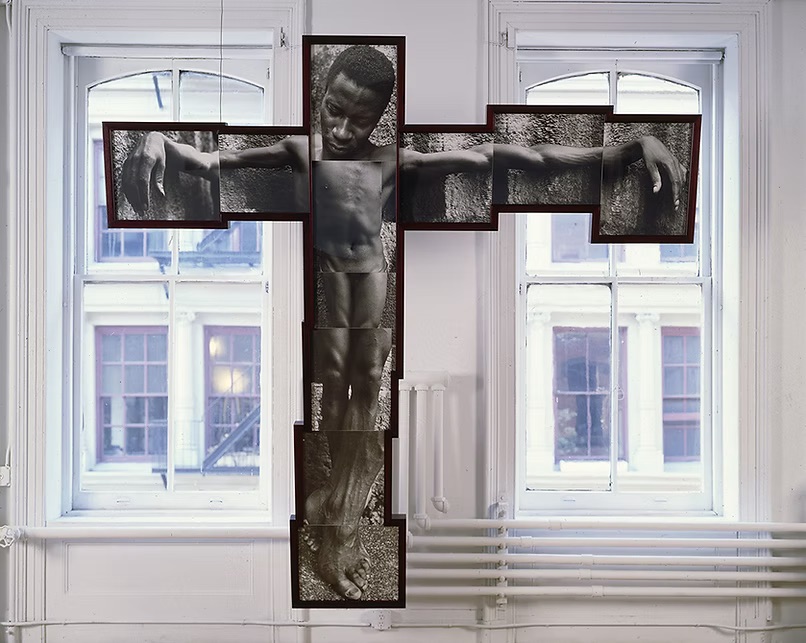
Notes on Black Suffering in the History of Art
The truest form of dehumanization is the alienation of one from their own body, a severing of self that renders flesh both object and spectacle. In nineteenth-century America, visual imagery emerged as a weapon, teaching a society to savor the pain of another as entertainment and evidence of natural order. White supremacist ideology, insisting that enslaved people were born for labor, found its fullest expression in these images, which circulated like currency, bought and sold alongside the bodies they depicted. Just as enslaved people were trafficked and erased, so too were their images—devoured by voracious eyes eager to reproduce the violence they observed… a sentiment I must say is disturbingly similar to our contemporary news cycle. Through this relentless gaze suffering was rendered indifferent and life itself rendered expendable. And yet, even within this apparatus of terror, abolitionists harnessed the same visual force, bending it against its masters, forcing the world to confront a truth it had long sought to ignore: that Black pain could not be unseen, and that witnessing might awaken justice.
The sensationalized portrayal of Black pain, crafted to shock, titillate, and provoke, marked a radical ideological shift that forced an uncomfortable reckoning with the power of the visual to distort humanity itself. It is as simple as this: photographs can never lie. One may choose to believe otherwise, to tell oneself that the enslaved have souls, that they should not be subjected to lives of terror. But when positioned before irrefutable evidence, when the image confronts the gaze with the weight of reality, even the weak-minded are compelled to believe what they see. This is not mere happenstance; it is a product of white supremacy as much as it is anti-Blackness, a calculated orchestration of perception that teaches the viewer how to see, how to believe, and how to ignore the ethical consequences of that vision. Beyond ideology, it is a systemic failure, a collective refusal to instruct individuals that their sight is as political, as socially consequential, and as morally charged as the words they utter, the thoughts they harbor, and the actions they perform.
Today, the digital realm extends this legacy with far greater stakes. AI-generated imagery and algorithmic systems designed to replicate, manipulate, and simulate reality inherit the same power to distort truth, fabricate evidence, normalize violence, and evade accountability, now operating at a nonhuman scale unburdened by even the faintest obligation toward empathy. We are confronted with visuals that appear undeniable, images that demand belief through their resemblance to reality, yet are constructed entirely to mislead. In a world where perception itself can be engineered, trust becomes unstable, and vision loses its ethical grounding. Within this terrain, Blackness, long subjected to the dual gaze of voyeurism and moral judgment, remains central to the machinery of spectacle, rendered persistently exploitable and uniquely vulnerable within the architecture of technological power.
Techno-Racism and Algorithmic Origins
Technology, as a practical application of scientific knowledge, has long been intertwined with mechanisms of control and subjugation—from the architectural mechanizations of slave ships to the design of voting systems. There is no doubt that algorithmic governance is a quickly growing regime of rule in contemporary life- actively participating in democratic politics at a microscopic and macroscopic level. Algorithms are neither inherently good nor evil; in their most basic form, they are sequences of instructions and lines of code designed to direct a computer to perform specific tasks. To most, they are nothing more and nothing less than what we intend them to be, but with the implication of a we, the algorithms we encounter become anything but neutral. As digital constructs, algorithms embody the biases of their creators and perpetuate prevailing societal narratives in which race is brought to the forefront as a design imperative.
Algorithmic governance has become a dominant regime of power in contemporary life. From predictive systems embedded in criminal justice to biometric technologies that regulate surveillance and recognition, digital infrastructures now participate directly in democratic life at both intimate and systemic levels. These systems do not merely reflect society but actively shape it. Embedded within their code are inherited logics of racial hierarchy, reproducing anti-Blackness as a structural condition rather than an incidental flaw. To understand representations of Blackness online, one must confront techno racism as a lived reality, not a metaphor. It names the convergence of racial violence and technological design, revealing how the same ideologies that structure the physical world are translated, refined, and automated within digital space.
The act of looking itself is disciplined by culture. Technologies are never neutral instruments but expressions of the values, fears, and desires of those who design and deploy them. Yet dominant narratives about race in America continue to disregard technology’s role, clinging to the fiction of a post racial society. As Bruce Sinclair observes in Integrating the Histories of Race and Technology, “The history of race in America has been written as if technologies scarcely existed, and the history of technology as if it were utterly innocent of racial significance. Neither of these assumptions bears scrutiny.” In practice, Blackness is rendered less as lived experience than as spectacle, endlessly circulated and consumed. Digital platforms rely on the repeated visibility of Black suffering, extracting attention and profit from scenes of pain. This dynamic reveals how techno racism operates through contradiction, producing hypervisibility without subjecthood. Despite the rhetoric of progress, these visual economies remain bound to older traditions of racial terror.
So to this, I pose a series of questions. What does it mean to call a system innovative when its ways of seeing are inherited, when its intelligence is trained on the same exclusions, and when its future is already structured by a brutal past? Is innovation real, or is it merely the refinement of domination under a new name? If the future must rely on anti-Blackness to function, was innovation ever real to begin with?
I suppose I have an answer to these questions, and I veer toward believing that innovation, the rapid dissemination of technology, is real, tangible, and materially effective. Things are easier, faster, more efficient. Communication collapses distance, information circulates at unprecedented speed, and new tools promise expanded access and possibility. Yet ease should not be mistaken for justice, nor efficiency for transformation. When technological advancement accelerates without a parallel ethical reckoning, it risks perfecting the very systems it claims to disrupt. What emerges is not a future freed from historical violence but one that carries it forward in more seamless, less visible forms. Innovation, in this sense, becomes less a break from the past than its most sophisticated continuation.
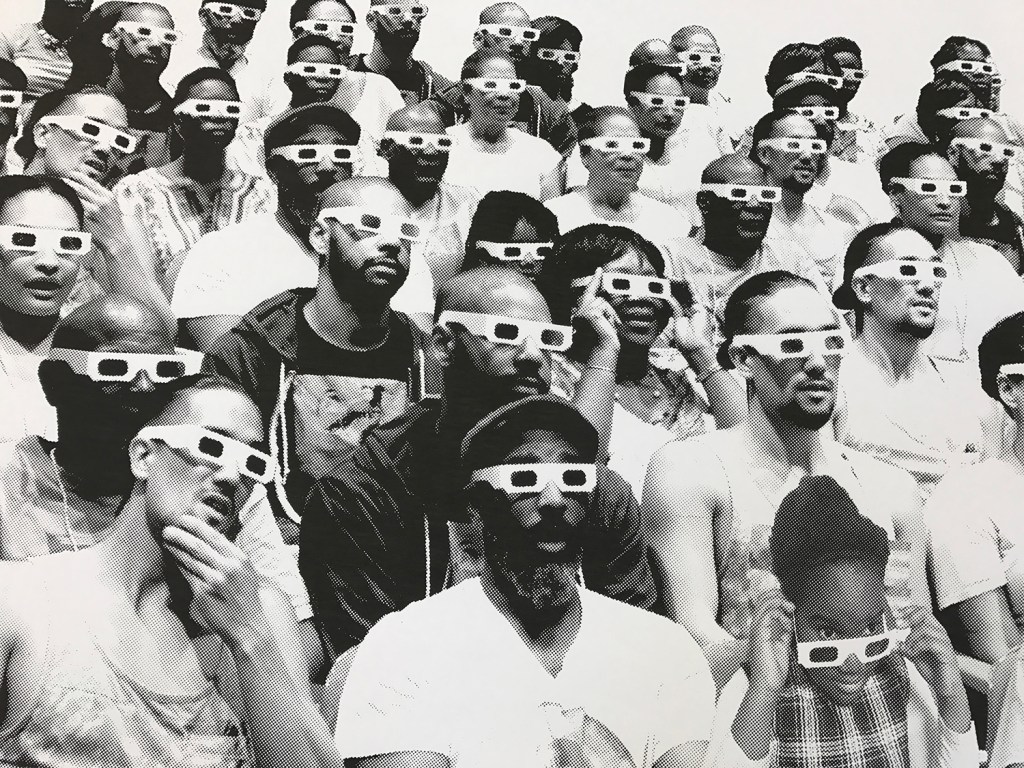
In our contemporary moment, the promise of progress is hollow, for what we call advancement too often masks the same systems of domination and oppression that shape our perceptions of possibility. And technology, with its design to replicate and systematize images of Black suffering, perpetuates a troubling tradition where Blackness remains a primary spectacle in global systems. From the circulation of lynching photography to the viral documentation of police brutality, each instance of sensationalized violence reflects a systemic issue, with every act serving as a distinct visual symptom of one another. And what emerges here is not simply a crisis of representation but a crisis of being seen. To exist within a visual order that renders the Black body as evidence before it is allowed to be human is to live within a split, a constant negotiation between selfhood and projection. Vision, in this sense, is never passive. It instructs, disciplines, and assigns value. What is made visible is not neutral, and what is repeated becomes doctrine. When suffering circulates without demand for care, when pain is rendered endlessly legible yet politically inert, the failure is not one of awareness but of ethical relation. Seeing, divorced from responsibility, becomes another form of possession.
Yet the act of looking does not have to reproduce harm. It can also be a practice of refusal, an insistence on tenderness where spectacle is expected. The question is not whether images will continue to shape our futures or even the algorithms in charge but whether we will allow them to do so without interrogation. Technologies that promise progress while feeding on inherited violence reveal a world unwilling to relinquish domination even in its most imaginative visions. If Blackness is continually positioned as the site through which brutality and fear is understood, then the work ahead is to dismantle the conditions that make such understanding possible. To imagine otherwise requires a recalibration of sight itself. A way of seeing that does not demand proof through injury, that does not confuse exposure with justice, that allows Black life to exist beyond its wounds. This is not an abstract ideal but an ethical necessity. Until our visual systems are restructured to honor care, imagination, and accountability, the future will remain tethered to a brutal past endlessly rehearsed. What is at stake is not visibility alone, but the right to be seen without being consumed.
 LECTA
LECTA 
Leave a comment