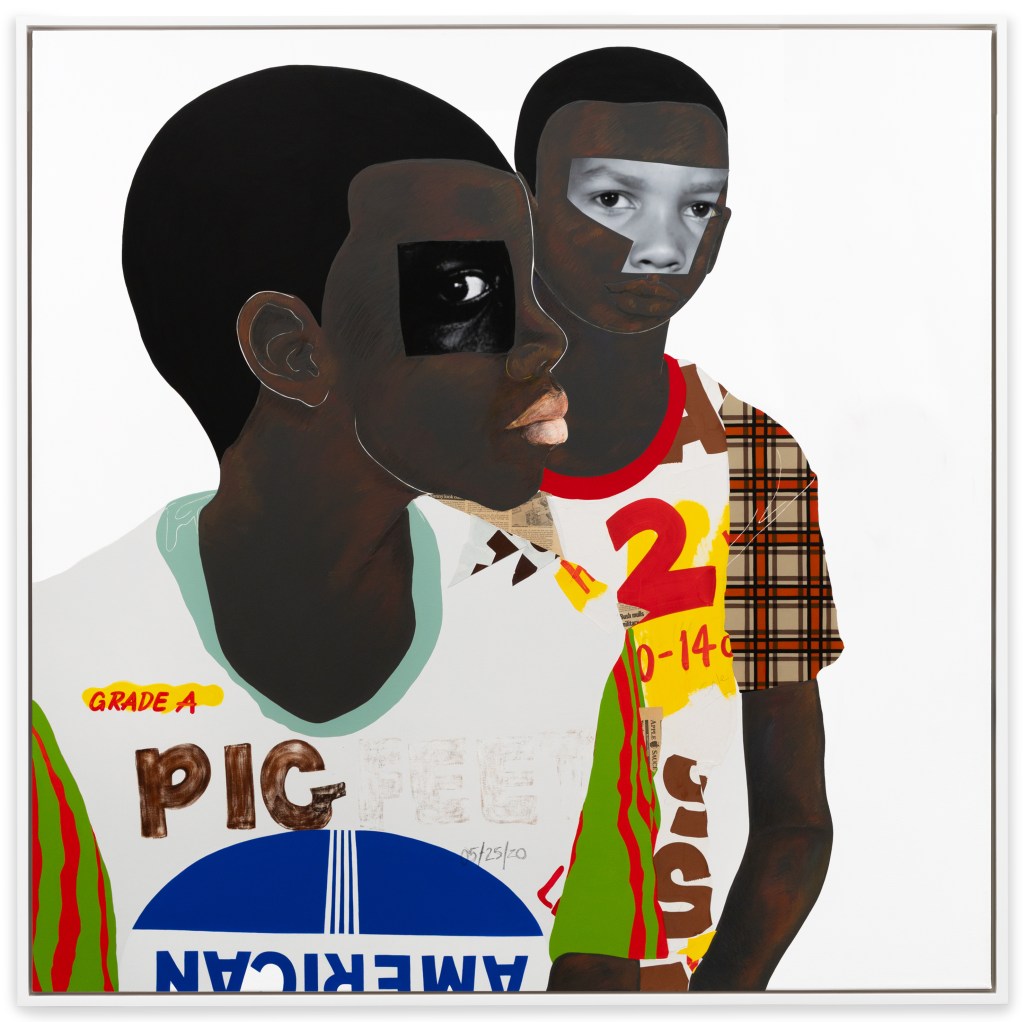
and collage on canvas, 177.8 x 177.8cm (70 x 70in). Copyright Deborah Roberts. Courtesy the artist and Stephen Friedman Gallery. Photo by Alex Boeschenstein
On Thursday, in the ninth floor exhibition space at The FLAG Art Foundation, the opening of Deborah Roberts: Consequences of being transformed what might have been a routine art world gathering into something quieter and more deliberate. The room did not rely on volume or spectacle. It relied on attention. Heels slowed. Conversations softened. The sense was not of frenzy, but of recognition that something in the room demanded to be met seriously.
By the time the elevator doors opened, it was clear that this was not a casual drop in. People stepped out composed but alert, as if crossing a threshold. Consequences of being carried that charge. You could feel it in the way viewers leaned in close, almost conspiratorially, to examine the abrupt seams where figuration meets paper. Deborah Roberts is known for her construction of figures from disparate visual fragments, centering Black children who remain among the most vulnerable subjects within American culture. Black children, so often flattened into trope or fantasy, emerge with her oeuvre as layered and sovereign figures, a deliberate cut and paste assertion of selfhood.
Adopting collage as a radical verb, Roberts brings structure to the white walled gallery space, transforming what might otherwise feel neutral into a site of visible construction. Collage here does not operate as embellishment or stylistic flourish. It functions as architecture. Each cut edge, each seam, each recalibrated proportion asserts that identity is assembled under pressure and with intention. The gallery’s presumed purity is unsettled by surfaces that refuse seamlessness.
The figures do not fade into the white walls. They confront them. By leaving the seams and cuts visible, Roberts disrupts the polished illusion long associated with traditional portraiture. Her bold use of mixed media, from photographic fragments to vivid clothing patterns, creates surfaces that feel deliberately charged rather than seamless. Within the space, her collaged subjects stand firmly in view, at times occupying nearly every corner of the gallery, overwhelming but necessarily so. The boldness that defines their bodies, the sharp articulation of each limb, and the unwavering intensity of their outward gaze assert an undeniable presence. Together, these formal decisions insist on complexity and resist any attempt at simplification or reduction.
Yet the authority Roberts grants these figures also carries risk. To monumentalize any subject is to enter a fragile space between protection and idealization. The works shield their subjects from distortion, but they also elevate them toward emblem. At moments the figuration edges toward the mythic, and with that elevation comes a subtle danger: in becoming symbol, the figure can drift from the human scale. Some viewers may recognize Roberts’s subjects as children and respond with empathy, yet still risk detaching them from the ordinary textures of lived experience. Monument can protect, but it can also abstract. Roberts moves along this boundary with care. Though her children bear symbolic weight, they never relinquish specificity. The visible cuts, slight disproportions, composite faces, and exposed seams anchor them in process rather than myth. They are not polished into untouchability. Her work resists sanctification and insists that Black subjecthood remain lived, imperfect, and embodied, even as it occupies the space of monument.
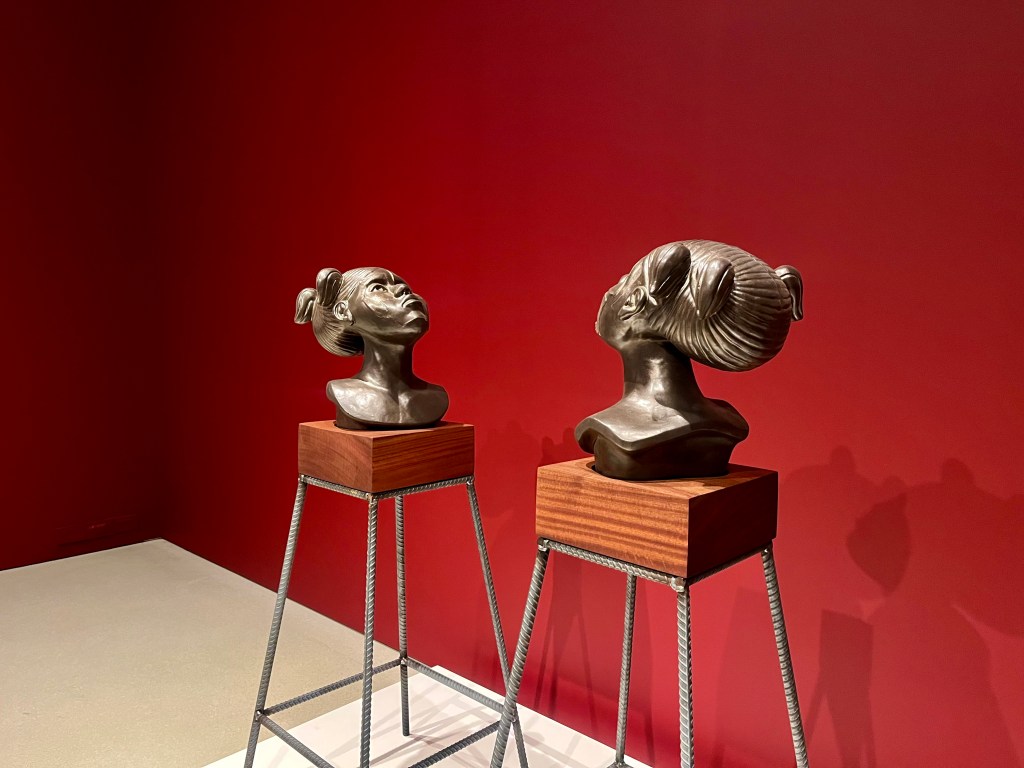
The stand out work, Zuri, a newly debuted ceramic sculpture whose title comes from the Swahili word for beautiful or good, commands its own space with quiet authority. In clay, Roberts translates her language of fragmentation into volume, extending her investigations of Black girlhood into the third dimension. The girls operate in concert, their busts angled upward and eyes wide open, fixed on a point beyond our field of vision. The installation creates a rhythm of lifted chins and suspended gestures, transforming upward orientation into a study of visibility, aspiration, and refusal within the history of figurative sculpture. There is a tension in their stance that recalls the charged pause before a game of double dutch, that suspended second when the body calculates entry. Their gaze does not signal innocence alone but a deliberate redirection of power, shifting the terms under which Black subjects have historically been looked at. The viewer’s instinct to follow their sightline produces a subtle destabilization. We become aware that whatever they see is not fully available to us. The withholding feels deliberate. We are not invited to possess the moment, only to stand beside it. Long and close looking is what Consequences of being demands.
And beyond these tensions, there is a current of joy. To stand in the room surrounded by such ambitious, larger than life children is to feel possibility press outward from the walls. The intensity of the work does not eclipse wonder. It sharpens it. Their presence recalls the elasticity of childhood, when each day felt expansive and the self was not yet fixed. For a moment, the exhibition returns us to that sensation, the belief that becoming is ongoing and that identity, like collage, can still be remade.
Leaving the gallery, consequence feels less like penalty and more like responsibility. Deborah Roberts refuses spectacle in favor of encounter, asking us to examine not only the history that shapes her figures but the habits of looking we bring to them. To view Deborah Roberts: Consequences of being is to reckon with the figurations that have long confined the wonder of being both Black and a child, and to glimpse the radical possibility of self construction. In a city built on the premise of reinvention, she offers something more difficult. Self possession.
Deborah Roberts: Consequences of being will be on view at The FLAG Art Foundation through April 25, 2026.
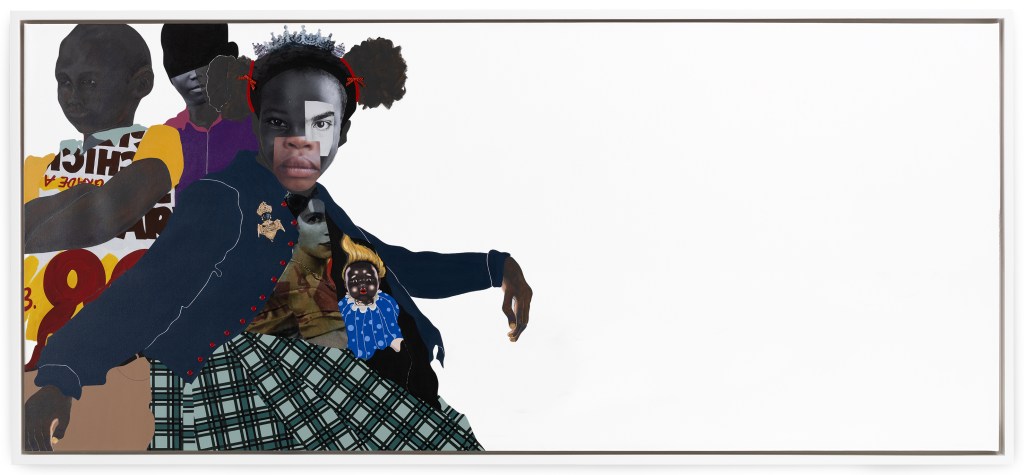
while’, 2025. Mixed media and collage on canvas, 139.7 x 317.5cm
(55 x 125in). Copyright Deborah Roberts. Courtesy the artist and Stephen Friedman Gallery. Photo by Paul Bardajgy
 LECTA
LECTA 
Leave a comment