
Norma Morgan’s work is prophetic, not because it predicts, but because it insists on a presence history has too often thinned and overlooked. Her etchings register as landscapes, yet they are studies in turbulence and restraint: clouds in motion, light piercing dense sky, figures half absorbed by mist. Trolls and mythic beings appear at the margins, embodiments of tension between memory and imagination. What she offers is not scenery but atmosphere, a charged terrain where survival and vision converge, where Black existence does not fade into the canonical horizon but endures, steady and unyielding.
Norma Gloria Morgan (1928- 2017) stands as a profound, yet often overlooked figure in the unfolding narrative of twentieth century American art. For over six decades, she moved between abstraction, landscape, and portraiture, weaving a practice that sidestepped the expected iconography of racial struggle demanded from her contemporaries. While Black power imagery entered the visual lexicon with urgency and force, Morgan turned instead toward the Scottish Highlands, the Catskills, and other wind struck terrains, rendering atmospheres thick with memory yet spare in overt signifiers of race. She remains obscured within the canon of Black art, yet the obscurity feels less like neglect than a willed positioning, an act of existing at a slant that her oeuvre repeatedly demonstrates. Even now, I encounter her through repeated mishaps, almost as if the archive itself is continually reluctant to yield her oeuvre and yet her work sharpens the tension between visibility and refusal and asks how Blackness endures when the scene appears untouched by humankind. Sitting with her prints, I wonder whether she is a missing piece in W. E. B. Du Bois’s theory of double consciousness, insisting on what it means to see and be seen in near darkness. There are, of course, many such missing pieces, but in my mind’s eye her work insists on this question.
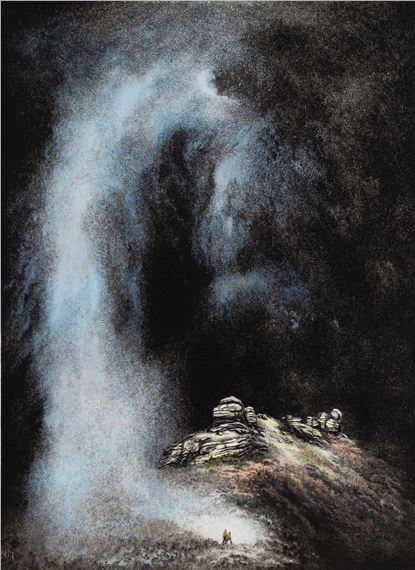
In Morgan’s large copperplate Arms Tor, Dartmoor (1988), what emerges is not merely a view of nature, but a landscape charged with psychic depth. Two small figures appear in the foreground, dwarfed by the overwhelming vastness of the moors. They seem almost entwined, charged with emotion as they traverse the terrain, perhaps alluding to humanity’s struggle with unpredictable natural forces. The wind appears to eclipse them, acting simultaneously as a force of erasure and equilibrium, setting in motion a stark contrast between light and dark while suggesting a desire to confront the unknown.
Above them looms a creature, possibly a dragon or spirit, its neck turned sharply downward as breath escapes its angular mouth. It reads as menacing yet watchful, as if guarding the figures or guiding them along an unusually illuminated path. Morgan fills the plate with an astonishing range of textures and tonal variation. The rocks are craggy and jagged, forming strange, almost sentient shapes against a dark, heavily worked backdrop. One is left to wonder whether the mountains extend beyond the darkness, and whether these figures are hikers, wanderers, or symbolic stand-ins for Morgan’s own rebellion. Are we meant to follow them this far, and what are we to make of the creature that presides over them? Is it a guardian or a threat? More urgently, why are the figures shrouded in such darkness? Are we meant to question their personhood or the grandiosity of their journey altogether?
I am most interested in her use of black, and in how the condition of being Black within a politically turbulent era generates a charged emotional register but becomes one with even the harshest of elements, earth itself. Beauty is not only serene for Morgan but turbulent, tethered to both the self and the unknown. In choosing to render such a harsh, eroding scene, one must ask whether the restrictions imposed upon her as a Black woman, who was arguably passing during her time period, did not provoke this stark creative response. In Arms Tor, struggle is not illustrated through racial iconography but encoded through formal intensity, through weather, shadow, and the restless line. Blackness is not absent but sublimated, transformed into an aesthetic of the sublime. And there is something profound in the convergence of Blackness and atmosphere in Morgan’s work that directly ties in with double consciousness, where identity is not declared but felt, suspended in shadow, weather, and the weight of the land itself. Du Bois describes double consciousness as “this sense of always looking at one’s self through the eyes of others… two souls, two thoughts, two unreconciled strivings.” (W.E.B DuBois, 1903) In Morgan’s hands, that twoness is not confined to the figure. It is diffused across the plate. Light and dark press against one another. Exposure and concealment coexist. The land itself seems to strain under the weight of competing perceptions. She offers a material vocabulary for Black consciousness that does not declare itself. Form and surface remain unsettled. This is not hesitation. It is structure.
If Du Bois names double consciousness as the condition of being at once inside oneself and outside oneself, Morgan distributes that condition across the visual field. There is no singular vantage point from which her work stabilizes. Layers partially obscure one another. Creatures press against quiet horizons. Depth is offered and then withdrawn. The viewer searches for coherence while encountering its refusal. Consciousness here is not split in two but dispersed across competing perceptual planes. But what does this reconfiguration answer? Art history has long accommodated Blackness in two dominant modes: as representation, where race is visible and narrativized, or as abstraction, where race is presumed to dissolve into form. Morgan disrupts this binary. Her landscapes are not “about” Blackness, nor do they escape it. They operate through what might be called Black atmospheric formalism, or more precisely, what I want to name Blackness in absentia: a structure in which Black consciousness is embedded not as iconography but as perceptual condition. This is a distinctly Black tension within the ephemeral realm, where Blackness is fissured into the landscape itself. Its power lies in its capacity to inhabit what appears as rudimentary as rock while remaining as profound as the sky itself. The etching carries philosophical Black thought as pressure rather than picture.
The question then shifts: is this an act of the sublime? The Western sublime traditionally stages transcendence through overwhelming nature, often erasing the subject in the face of magnitude. But I argue that Morgan does something subtler. She does not dissolve her subjects into vastness, she fractures the ground itself. The instability is not cosmic but structural. It does not promise transcendence but rather introduces into the canon a model of sublimity that exists on endurance. This is a sublimity that keeps the viewer within history, suspended in multiplicity. Rather than chasing a new world, Morgan reconfigures the one already underneath us. In doing so, she refuses the innate escapism embedded in the white sublime and instead reconfigures perception from within.
Visibility does not guarantee recognition. Recognition does not guarantee belonging. And belonging does not require readability. Morgan offers not simply a Black landscape, but a landscape structured by Black consciousness without thematic insistence. Though working in the twentieth century, she gestures toward futurity, arguing materially that Black transcendence is not an elevated moment but a sustained capacity. It does not erupt. It endures. Her landscapes model survival within history, showing that Black consciousness need not declare itself to transform the field.
MORE RESEARCH
 LECTA
LECTA 
Leave a comment