
Henry Ossawa Tanner’s (1859–1937) work has returned to my theoretical research with a kind of insistence that feels difficult to ignore. He occupies a significant place within the art historical canon as one of the first Black artists to achieve international recognition, yet I keep returning to what remains unresolved in how his work is read. This is where I began to think through a concept I call Blackness in absentia: the idea that Black presence can shape a work of art even when it is not explicitly depicted. Rather than relying on explicit figuration, it’s an approach that questions what it means when Black life is embedded in atmosphere, structure, and emotional logic instead.
I first began thinking along these lines while studying the work of Norma Morgan, a traveler whose creative practice remains deeply important to me, and from there I rediscovered Tanner. The transition felt almost inevitable, guided by a simple yet disruptive question that continues to occupy me: What if, instead of beginning with absence, we began with the assumption that Black life has always already been there and will continue to be there? What shifts when the task is no longer one of discovery, but one of recognition? These questions emerge from my forever discomfort with the ways Blackness is continually placed in a loop of limitation and silencing across museums, galleries, and the digital spaces that shape our understanding of art. Visibility can create the appearance of inclusion while leaving older structures of exclusion intact. And yet I must continually remind myself that absence is not disappearance.
A favorite of mine, Christ Walking on the Water (late 19th to early 20th century), became a site through which this question took form. It is a turbulent biblical scene in which atmosphere, light, and suspended perception dominate over explicit figuration. Meaning is carried as much through what is withheld as through what is shown, raising a central question: How does Henry Ossawa Tanner’s religious imagery, particularly Christ Walking on the Water, produce a spiritual and aesthetic space in which Blackness operates through absence rather than representation?
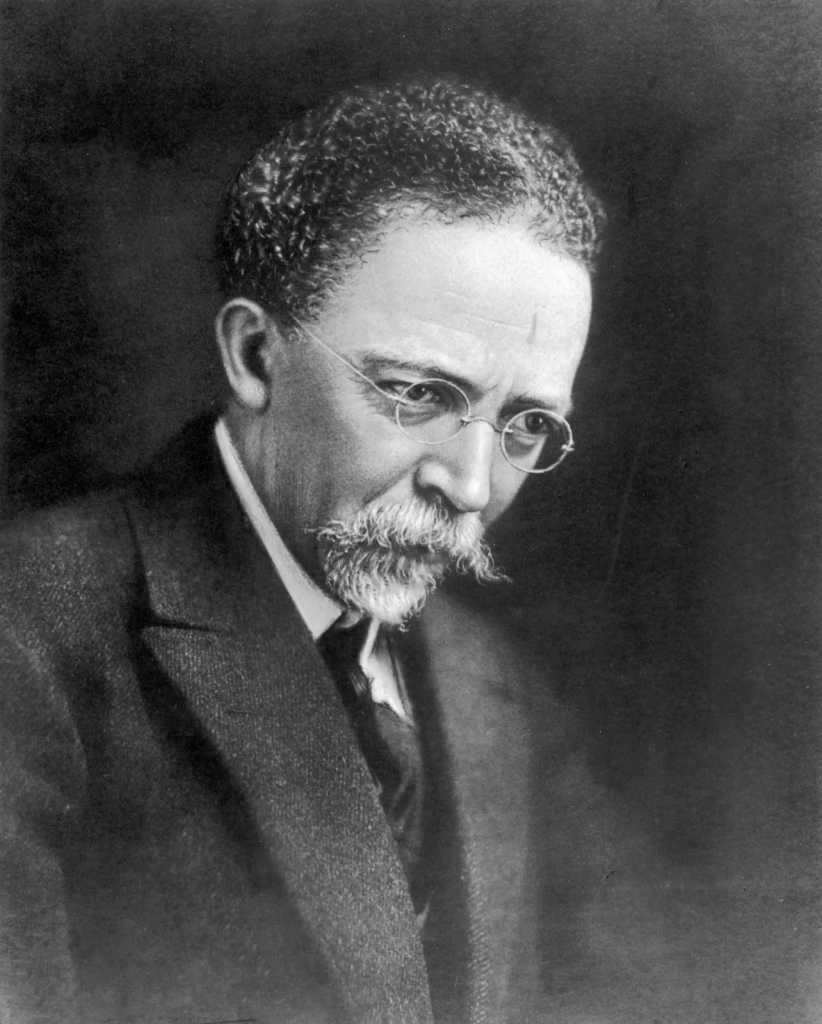
Born in Pittsburgh, Pennsylvania to Sarah Miller, a formerly enslaved woman, and Benjamin Tucker Tanner, a pastor who later became a bishop in the African Methodist Episcopal Church, Henry Ossawa Tanner was shaped by both racial struggle and religious conviction. He studied at the Pennsylvania Academy of the Fine Arts in Philadelphia under artist Thomas Eakins, before continuing his work abroad in Paris, Jerusalem, Cairo, and Morocco. His path was singular, a journey that evokes a kind of spiritual exodus and as an African-American working in the age of Jim Crow a journey such as Tanner’s demanded a high price.
Complicating this journey was the ambiguity of Tanner’s racial legibility. His mother, the daughter of a white Virginia plantation owner, had been born into slavery, and Tanner’s own light complexion often positioned him uneasily within the rigid racial categories of the nineteenth century. He was frequently described as having little to no visible trace of African ancestry. Accounts emphasized his Aryan-like gray eyes, his complexion at times rendered ghostly white until darkened by the sun, and his Romanesque features framed by thick, dark curls. As art historian Albert Boime notes, “Tanner was a light-skinned Black at a time when color differentiation functioned as an intra-group stratifier as well as a social signifier for the dominant white society. His development as an artist-producer is inseparable from his cross-cultural social relationships.” [Albert Boime, “Henry Ossawa Tanner’s Subversion of Genre,” The Art Bulletin 75, no. 3 (1993): pg. 415]
And while some attempt to separate Tanner’s artistic achievements from questions of race, his movement through artistic circles and his ability to travel abroad cannot be disentangled from the racial ambiguity that shaped his life. I do not dismiss these descriptions, nor do I accept them uncritically. Rather, I have come to understand Tanner’s life and work as extraordinary precisely because he did not operate within the ordinary terms of racial legibility available to him. He inhabited an in-between space, suspended between Blackness and proximity to whiteness, between racial representation and racial evasion. This tension was not imposed upon him solely by others; it was one that Tanner openly grappled with himself. Responding to an American critic who questioned his racial identity, Tanner wrote:
“Now am I a Negro? Does not the ¾ of English blood in my veins, which when it flowed in pure Anglo-Saxon men and which has done in the past effective and distinguished work in the U.S.- does this not count for anything? Does the ¼ or ⅛ of ‘pure’ Negro blood in my veins count for all? I believe it, the Negro blood counts and counts to my advantage- though it has caused me at time a life of great humiliation and sorrow. But that is the source of all my talents (if I have any) I do not believe, any more than I believe it all comes from my English ancestor.” [Marley, Anna O., ed., Henry Ossawa Tanner: Modern Spirit, p 139.]
Tanner’s reply is not a rejection of Blackness, but a clear frustration with the violent rigidity of racial classification itself. But it is important to note the juxtaposition here: despite Tanner’s resistance and discomfort with racial categorization, his work was deeply significant to the canon of Black art. During his lifetime, his paintings operated not only as sites of beauty, but also as representations of Black dignity and self-determination within a larger ongoing struggle for equality. And whether Tanner intended on assuming this responsibility, the foundation of his becoming was Black— even as he moved from tender portrayals of Southern Black life to landscapes, animals, and eventually the religious imagery that came to define his career in Paris.
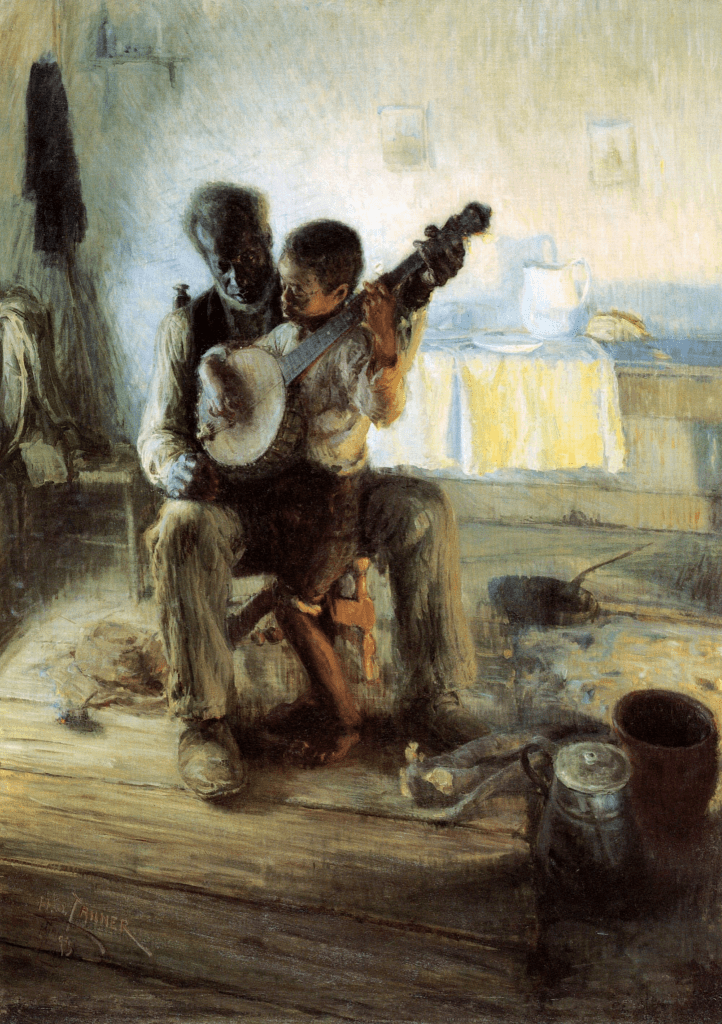
In 1894, The Bango Lesson (1893) became Tanner’s first accepted work at the Paris Salon. The piece had been years in the making, developing out of sketches Tanner produced while visiting the Blue Ridge Mountains of North Carolina. It depicts an elderly Black man cradling a young boy within the intimate confines of a modest log cabin. The child grips a large banjo with both hands, his gaze directed downward in concentrated attention as though absorbing the quiet instruction of his grandfather. The older man gently supports the instrument with one hand so that its weight does not overwhelm the boy, yet he does not fully guide him. Instead, the scene suggests that the child must arrive at an understanding of music through his own practice. The cabin itself is sparse but rendered with warmth and dignity. A soft golden light, perhaps emanating from a nearby fire, saturates the interior and transforms the otherwise modest space into one of emotional depth and spiritual fullness. Tanner’s careful manipulation of light and atmosphere enlarges the room, allowing intergenerational care to become the true subjects of the painting. The work was poorly understood by Paris critics and reduced to stereotypical caricatures. Soon after, Tanner created The Thankful Poor (1894), which remains his last known Black genre painting to date.
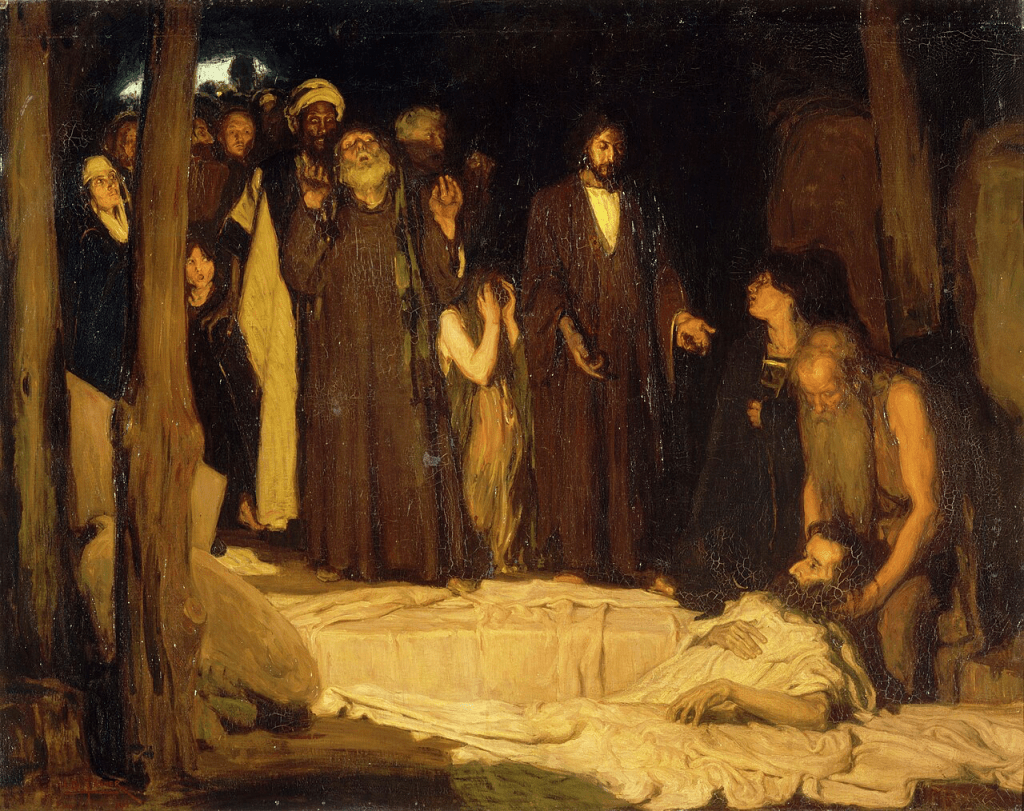
Tanner entered this painting into the 1897 Paris Salon and won a third place medal.
In both works, the theme of spiritual solace found within French Realism is distinct, yet both were met with limited formal success, revealing the criticism Tanner faced in attempting to render dignified representations of Black life within a global art economy deeply invested in racial caricature. Put simply, the art world of Tanner’s time, along with the inherited frameworks that continue to shape it, was not and still is not fully prepared to recognize Black self determination.
“Despite the fact that an African American genre paintings would also have been reproduced and sold by subscription, he would have continued to paint Black subjects. Without the support of his people or a demand from the general American art-buying public, it was clear that France held the key to his future as an artist… His career as a painter who focused on Black genre subjects was over.” [Naurice Frank Woods, Jr., Art, Faith, Race, and Legacy, p 91.]
Although Tanner demonstrated technical mastery across genres, his success coincided with a gradual shift away from explicitly Black subject matter, as shown by the acclaim surrounding The Resurrection of Lazarus (1896). In many ways, this shift was a strategic negotiation familiar to Black creatives navigating institutions structured by exclusion. To gain entry into circles of academic traditionalism, Tanner increasingly moved away from the racial specificity that had distinguished his earlier work. To be accepted was to be seen, and visibility within the Paris Salon offered a form of artistic legitimacy largely unavailable to most artists. Yet Christ Walking on Water complicates this narrative. Rather than signaling a complete departure from Black representation, the etching suggests that Tanner may have transformed the terms through which Blackness could appear. What emerges is not the disappearance of Black life from his work, but its migration into a different register, one less concerned with public declaration than with visual suggestion and encoded presence.
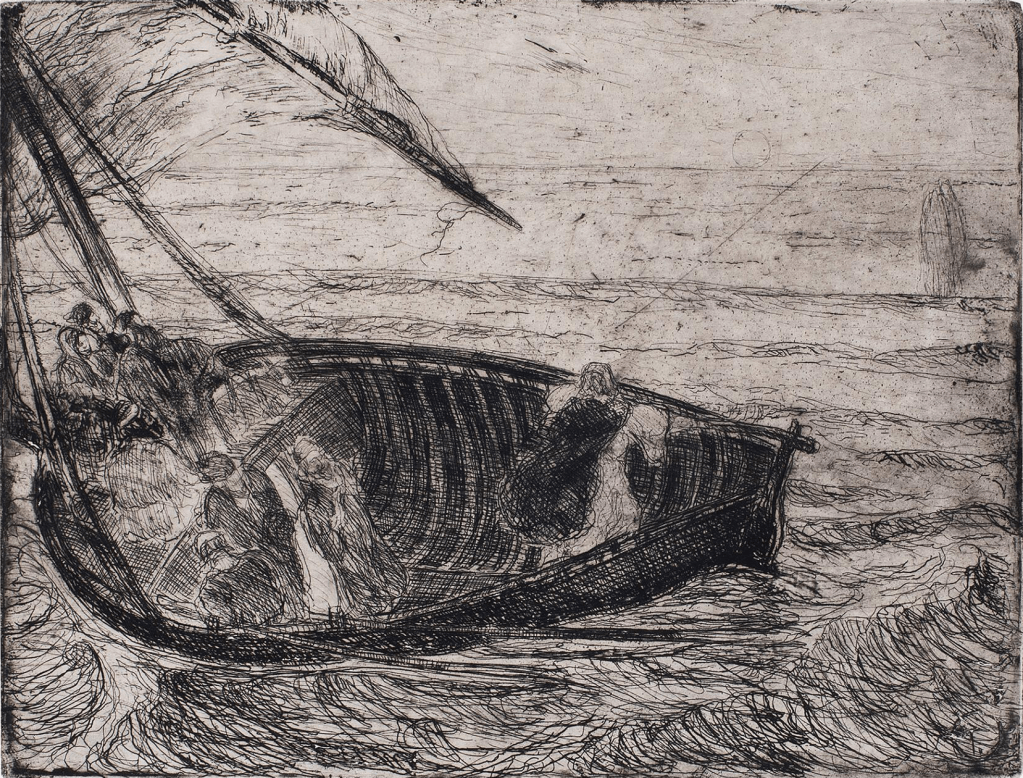
Etching in black on laid paper
In looking at Christ Walking on the Water, the etching is first characterized by the quiet emotional intensity of sketching. Through the use of chiaroscuro and a muted but powerful gray color palette Tanner renders a turbulent ocean. There is no clear distinction between sea and sky except for a small circle on the horizon, perhaps indicative of a setting sun. Many landscapes clearly define horizon and space, but here the two merge, flattening depth and reinforcing a sense of instability and uncertainty. This is a landscape but it doesn’t fit exactly within the parameters of beauty, the sublime and the picturesque. It operates in its own fourth realm- to which I don’t have a name. In the foreground, a wooden boat occupies most of the visual plane, carrying around ten passengers. It is a simple vessel, suggesting that the journey is relatively short despite the ferocious nature of the waves. The ship’s mast and sail appear disproportionately large in relation to its fragile wooden frame, emphasizing a structural imbalance that extends beyond the vessel itself. The water is most violent in the foreground all while the waves soften towards the horizon, suggesting a possible shore right beyond the paper’s end. And the possibility of submerged rocks adding to this scene right at the possible end of the ship’s journey further complicates the scene, reinforcing the passengers’ position at the threshold between danger and revelation. There is an added dimension where the stillness surrounding Christ is indicative of the representation at hand. It’s a chaos that we typically do not see in Tanner’s religious scenes but a scene that could only arguably arise from the chaos of the transatlantic slave trade itself.
The scene immediately raises questions of direction and destination: where could they be going, and who does the ship hold? Although the drawing’s muted palette leaves much to the imagination and Tanner’s rigorous sketching resists full resolution of figuration, it is clear that the passengers are critical to the scene. The most distinct figure is a man near the center, clutching the edge of the boat. His pale face suggests he is white, and his hair thins at the crown while his clothing billows as wind and water threaten to overturn him. His dress is of note, with an exaggerated puffed sleeve and cape recalling 19th-century revivals of Tudor and Elizabethan fashion, where men’s attire remained structured and ceremonial. At first glance, he appears to cling to the boat for stability but in following his gaze, directed by Tanner’s subtle line work, viewers are led to a figure standing on the water— Christ himself. Christ is rendered in minimal ghostlike strokes, reduced to enough marks to identify him but not fully to contain him, rendered to the far right of the drawing as if he is hovering at the edge of material presence himself. It is here Tanner directly draws from a passage described in the book of Matthew: “Shortly before dawn Jesus went out to them, walking on the lake. When the disciples saw him walking on the lake, they were terrified. “It’s a ghost,”they said, and cried out in fear.” [Matthew 14:22–33]
The other figures are harder to distinguish, clustered toward the back of the boat, their pale faces shown in profile and their garments heavy and thickened for travel. They may be passengers or crew, or simply witnesses to the unfolding miracle, positioned between control and surrender. Most striking, however, is a kneeling figure beneath them near the helm. This individual is markedly darker than the rest of the passengers, their face repeatedly reworked so that it appears almost obscured, as if rendered in a dense, metallic blackness like an iron muzzle. Their hair rises in a textured cacophony of sketch marks, evoking intricate 19th-century West African hairstyles. Their white dress contrasts sharply with their darkened face, emphasizing the thinness of their clothing and the thin line between visibility and erasure Tanner often plays with. They hold a muddled object, perhaps a rag, in their hand, while they kneel beneath the surrounding passengers. Their posture suggests both a position of menial labor and a long endured understanding of one’s standing, or lack thereof, which complicates the scene’s shared sense of vulnerability to now include the forced racial hierarchies and historical violences embedded within salvation itself. Light also emanates from the figure through Tanner’s intense chiaroscuro, with subtle illumination from below and reduced shading on their clothing to emphasize the figure as a primary source of light and evokes a moment of divine presence within an otherwise darkened space.
The presence of this Black figure raises a series of uneasy questions that resist resolution. Why does Tanner return to this biblical scene in its traditional setting, only to subtly shift its visual logic toward histories that echo slavery itself? How does this figure complicate Tanner’s own sense of self, his understanding of belonging, visibility, and spiritual inheritance? These are not questions that the painting answers so much as questions it holds open.
There is a fragility here that Tanner seems to work within rather than resolve. The miracle does not arrive as a fixed moment of transcendence, but as something unstable, shaped by who is allowed to witness it and under what conditions. And so another question surfaces, more difficult still: what does it mean for the miracle of Christ to be witnessed through the figure of the enslaved? Not as metaphor, but as a historical residue that refuses to fully disappear from the scene.
In this tension, the sacred is never untouched by the social. It is precisely this entanglement that unsettles any simple reading of grace, revelation, or humanity itself.
Across Tanner’s oeuvre, race is not absent but redistributed into the very conditions of perception. Stillness, distance, and atmospheric opacity become the means through which racial experience is organized and at times, hidden. While Tanner does not present Blackness as a figure of explicit recognition in Christ Walking on Water, the work still cannot be read outside the histories that determine who is made visible, and under what conditions. What appears to be a matter of figuration and biblical narrative is ultimately a question of spectatorship—one where faith and vulnerability are staged through a deliberately uneven legibility.
Christ Walking on Water is an almost prophetic rendering of divine encounter, but also a scene in which Blackness is quietly rehearsed within the limits of the visible. The Thankful Poor (1894) continues to be recognized as Tanner’s last major Black genre painting, yet there remains another interpretive possibility: that Tanner never abandoned Blackness but instead transformed the manner through which it was rendered. Much like the codes Tanner himself had to navigate between racial worlds, there is evidence that he encoded Blackness within spaces of visual ambiguity, embedding it within atmosphere, gesture, and instability rather than explicit figuration. In this sense, Blackness in absentia becomes a way of thinking through both Tanner’s lived condition and his artistic practice. It is not a claim about Black absence or an attempt to recover missing Black narratives from the canon of art history. Rather, it refuses absence as a stable category altogether, marking the way Black presence persists through form, atmosphere, and affect. It is ultimately a method for reading Blackness in scenes and between worlds where it is not explicitly shown and perhaps the impossibility of recognition in Christ Walking on Water is precisely the point.
For Tanner, creating was not incidental. It was a talent that demanded rigor and full realization, and beyond that, it functioned as a practice of biblical weight. There are so many ideas running through my mind’s eye, but I wish to close with what I identify as the fourth realm, a space where Blackness operates through absence and where the visual field holds forms of experience that traditional art historical frameworks struggle to fully articulate. Tanner unsettles the idea of a neutral or universal sacred space long upheld in the French Salon tradition. But even more so, he undermines the very act that runs through art history itself: the act of witnessing. He opens us to a world in which sight is uneven, a fragile human encounter in which faith and recognition have long convinced us that what we see is equivalent to belief itself.
In this sense, the fourth realm is not a space beyond history or race, but the very field in which their entanglement becomes visible. It is where absence is never empty, where visibility is never neutral, and where looking itself becomes a site of negotiation, fracture, and care. Perhaps this is why I continue to return to Christ Walking on the Water. Not because it offers answers, but because it refuses easy resolution. I am not a Tanner scholar, nor do I claim expertise over the full scope of his oeuvre. What I carry instead is a sustained curiosity, a feeling that there is still more to see. And if Christ Walking on the Water teaches us anything, it may be that recognition is never a finished act. We return to the image, and in returning, discover that it has been waiting for us to learn how to look.


Leave a Reply